May 15th, 2026 – Google just published its first official guide on optimizing for AI Overviews and AI Mode. Here are the 6 tactics you should stop paying for immediately and the 2 new frontiers most SEOs are ignoring.
The One-Sentence Verdict
On May 15, 2026, Google published ‘Optimizing your website for generative AI features on Google Search.’ After 18 months of vendor debate, the answer is definitive:
“Optimizing for generative AI search is optimizing for the search experience, and thus still SEO.”
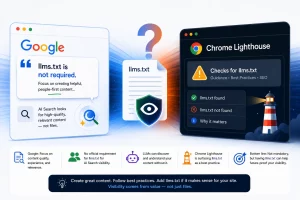
There is no llms.txt requirement. No AI-specific schema. No forced content chunking. No AI-only rewrite protocol. No page-per-query-variation production line. And critically some of the tactics vendors have been selling are now explicitly flagged as violating Google’s spam policy.
If your AEO vendor is recommending any of the below as a path to Google AI visibility, you now have a published standard to audit them against, and in some cases, a policy violation to cite.
Why This Is the Most Important SEO Document of 2026
For 18 months, the AEO/GEO vendor category operated without a rulebook from any major AI search provider. That vacuum created room for tactics-first marketing: vendors claimed that adding llms.txt, stuffing FAQ schema, or generating 50 pages per fan-out cluster was the way to win AI Overview citations.
Without an official Google position, enterprise buyers had no clean way to falsify those claims. Many of those tactics were sold into AEO programs at meaningful budgets.
Google’s May 2026 guide closes that ambiguity. It names with unusual specificity the patterns Google does not require. And it goes further: it explicitly warns that some of these practices violate Google’s scaled content abuse spam policy.
How Google’s AI Search Actually Works: RAG + Query Fan-Out
Google highlights two technical concepts every SEO must understand:
1. Retrieval-Augmented Generation (RAG)
“A technique (also known as grounding) used to improve the quality, accuracy, and freshness of AI responses by relying on our core Search ranking systems to retrieve relevant, up-to-date web pages from our Search index.”
Your content must first be indexed and ranked by traditional Search systems before it can be cited in an AI Overview. There is no ‘AI bypass’ around SEO fundamentals. Google’s AI systems review the specific information from retrieved pages to generate a response, showing prominent, clickable links to the sources.
Practical implication: if your page isn’t ranking for related queries, it won’t be retrieved for AI Overviews. Technical accessibility and content quality are prerequisites, not optional add-ons.
2. Query Fan-Out
“A set of concurrent, related queries generated by the model to request more information and fetch additional relevant search results to address the user’s query.”
Example: if the original query is ‘how to fix a lawn that’s full of weeds,’ fan-out queries might include ‘best herbicides for lawns,’ ‘remove weeds without chemicals,’ and ‘how to prevent weeds in lawn.’
Practical implication: your content can surface even if it doesn’t match the exact wording of the original query but only if it is already indexed, relevant, and authoritative. Topic clusters and internal linking architectures matter more than ever. A single well-structured pillar page can influence multiple fan-out queries.
The 5 Things Google Explicitly Wants You to Do
1. Publish Non-Commodity Content with a Distinctive Point of View
Google’s exact framing contrasts two examples:
- Commodity content: ‘7 Tips for First-Time Homebuyers’ based on common knowledge, adds little unique insight
- Non-commodity content: ‘Why We Waived the Inspection & Saved Money: A Look Inside the Sewer Line’ unique expert or experienced takes that go beyond common knowledge
“Create the content yourself based on what you know about the topic, and consider what in-depth experience you can bring to your content. Don’t just recycle what others on the internet have already said, or could easily be produced by a generative AI model.”
Action for content teams: brief writers on point of view first, structure second. If a draft can be reproduced by paraphrasing the top three SERP results, it does not meet the bar.
2. Organize Content for Human Readers First
“Write content for your human audience and make sure the content is well written and easy to follow. People generally appreciate it when web pages are organized by paragraphs and sections, along with headings that provide a clear structure to navigate content.”
This is editorial clarity, not an AI optimization trick. The same structure happens to make RAG-based engines more likely to lift clean passages, but Google is explicit that this is human-first.
Action: audit your top 20 pages. Are H2s descriptive? Do sections stand alone? Can a reader skim and still extract value?
3. Invest in Original Images and Video
“Many people appreciate finding images and videos as they search for things online… look for ways to support your textual content with high-quality, relevant images and videos on your pages.”
Google’s AI features can surface images and videos directly in answers. Original media product shots, diagrams, customer footage, charts of your own data extends AI visibility beyond text links.
Action: replace stock imagery with original photography or data visualizations on your top 10 traffic pages this quarter.
4. Maintain Technical Accessibility
Google lists specific requirements:
- Meet Search technical requirements: indexed and eligible to be shown in Google Search with a snippet
- Follow crawling best practices: ensure content is crawlable; Google Search generative AI models use publicly accessible, crawlable content
- Semantic HTML: focus on human readability; don’t worry about perfect code, but use semantic HTML when possible as it helps other types of users (screen readers)
- JavaScript SEO best practices: Google can process content within JavaScript as long as it isn’t blocked
- Good page experience: displays well across all devices, reducing latency, easy to distinguish main content
- Reduce duplicate content: bad user experience; search engines might waste crawling resources on URLs you don’t care about
Action: run a Search Console coverage report. Fix any ‘Excluded’ or ‘Not indexed’ issues on priority pages before spending another dollar on content.
5. Feed Structured Commercial and Local Data
“Using products like Merchant Center (such as Merchant Center feeds) and Google Business Profiles can help your products and services to be visible in both AI responses and other Google Search results.”
AI answers cite product listings, product information, and local business details directly. These are the structured-data sources Google AI features actually use, not freeform AI-specific schema.
Action: verify your Merchant Center feed is error-free and your GBP categories are accurate. These are citation sources, not optional add-ons.
The 6 AEO Tactics Google Explicitly Rejects (And One That’s Now Spam)
This is the part of the guide that retired several common vendor pitches. Each line below is quoted or closely paraphrased from Google’s published language.
| # | Tactic | Google’s Exact Position |
| 1 | llms.txt or special AI markup files | “You don’t need to create new machine readable files, AI text files, markup, or Markdown to appear in generative AI search.” Note: Google may discover, crawl, and index many kinds of files this doesn’t mean the file is treated in a special way. |
| 2 | “Chunking” content for AI extraction | “There’s no requirement to break your content into tiny pieces for AI to better understand it. Google systems are able to understand the nuance of multiple topics on a page and show the relevant piece to users… There’s no ideal page length, and in the end, make pages for your audience, not just for generative AI search.” |
| 3 | Rewriting content just for AI systems | “You don’t need to write in a specific way just for generative AI search. AI systems can understand synonyms and general meanings… you don’t have to worry that you don’t have enough ‘long-tail’ keywords or haven’t captured every variation.” |
| 4 | Seeking inauthentic “mentions” | “Seeking inauthentic ‘mentions’ across the web isn’t as helpful as it might seem.” Google’s core ranking systems focus on high-quality content while other systems block spam. |
| 5 | Overfocusing on structured data | “Structured data isn’t required for generative AI search, and there’s no special schema.org markup you need to add. However, it’s a good idea to continue using it as part of your overall SEO strategy.” |
| 6 | Volume over quality / page-per-variation | “A high quantity of pages doesn’t make a website higher quality or more relevant to users.” CRITICAL: “doing so primarily to manipulate rankings or generative AI responses in Google Search violates Google’s scaled content abuse spam policy.” |
The Hidden Section Most SEOs Missed: Agentic Experiences
Google dedicates a full section to AI agents autonomous systems that perform tasks on behalf of people, such as booking reservations or comparing product specifications.
“These agents can take many forms; for example, browser agents may access your website to gather the data they need to complete these tasks, such as analyzing visual renderings (like screenshots), inspecting the DOM structure, and interpreting the accessibility tree.”
Google points to agent-friendly website best practices and emerging protocols like the Universal Commerce Protocol (UCP) that will allow Search agents to do more.
Strategic implication: this is not theoretical. Browser agents are already accessing your site to complete tasks. If your site has broken DOM structure, inaccessible forms, or unclear product specifications, agents will fail and your brand will not be recommended.
Action: audit your checkout flow, contact forms, and product comparison pages for agent accessibility. This is the next technical SEO frontier.
Google’s Companion Guidance: Using Generative AI Content on Your Website
Google published a separate but related guide: ‘Guidance on using generative AI content on your website.’ Key points for CMOs:
- Accuracy, quality, and relevance: when automatically generating content, ensure metadata (title, meta description, structured data, alt text) is accurate
- Structured data compliance: validate markup to ensure eligibility for Search features
- Give users context: share information about how a piece of content was created; add image metadata for AI-generated images
- E-commerce specific: Google Merchant Center has policies for AI-generated content; AI-generated images must contain IPTC DigitalSourceType TrainedAlgorithmicMedia metadata; AI-generated product data must be labeled as AI-generated
If you are using AI tools for content creation, this companion guide is mandatory reading.
From Rankings to Influence: The Metric Shift CMOs Must Make
Historically, SEO success was measured through rankings, clicks, and conversions. In AI search, your content may influence decisions even if users never click through to your site.
An AI assistant may cite your brand, prompting the user to search for you directly later. Or it may surface your product image in an AI Mode answer, building awareness without a click.
This makes influence the new currency. Track:
- Branded search growth (Search Console → Performance → Queries containing your brand)
- Direct and returning traffic (GA4 → Traffic acquisition → Direct)
- Homepage visits (often the first action after an AI citation)
- Assisted conversions (multi-touch attribution in GA4)
- AI citation frequency (Bing Webmaster Tools → AI Performance report — the first major platform feature showing how often your content is cited in AI-generated answers)
The 7-Question CMO Audit: Run This in 30 Days
- Does our AEO plan recommend any of the 6 named anti-patterns above? If yes, what is the named evidence supporting it, and is it engine-specific or generic?
- Are we producing content that violates Google’s scaled content abuse policy? Any page-per-query-variation production lines running right now?
- What percentage of our last two quarters’ content meets Google’s non-commodity test (unique POV, first-hand evidence, original framework, or verifiable data)?
- Is our visual evidence original or stock? Where can we replace stock with proprietary photography, diagrams, or data charts this quarter?
- Do priority pages pass technical accessibility? Search Console verified, no inappropriate noindex, semantic HTML, structured data matching visible content?
- Have we audited for agentic accessibility? Can a browser agent complete a reservation, comparison, or purchase on our site using DOM structure and visual rendering alone?
- If a journalist asked us to defend our top 3 AEO claims with sources, could we?
The 90-Day Action Plan
| Week | Action | Owner |
| 1-2 | Audit current AEO vendor deliverables against the 6 anti-patterns + scaled content abuse policy | CMO / VP Marketing |
| 2-3 | Content audit: flag commodity content for rewrite; identify scaled content abuse risks | Content Lead |
| 3-4 | Technical audit: crawlability, indexability, semantic HTML, structured data mismatches | SEO Manager |
| 5-6 | Original media production plan + AI-generated image metadata compliance (IPTC DigitalSourceType) | Creative / Content |
| 7-8 | Agentic accessibility audit: checkout flows, forms, product comparison pages | Dev / UX |
| 9-10 | Set up Bing Webmaster Tools AI Performance report + branded search dashboards | SEO / Analytics |
| 11-12 | Publish first non-commodity content piece with original research or first-hand evidence | Content Lead |
Final Word: The Real Opportunity
AI search will reward brands that are:
- Credible (authoritative, well-sourced, technically sound)
- Specific (original insights, not generic summaries)
- Structured (clear hierarchies, strong internal linking, clean HTML, agent-accessible)
- Consistent (up-to-date, minimal duplication, coherent terminology)
If your website becomes the most trusted source in your niche, AI systems are more likely to cite and recommend you.
Google’s message is simple: strong SEO fundamentals still drive visibility.
The emerging message on agents is strategic: structure your site so autonomous systems can complete tasks on your behalf.
Put together, the takeaway is clear: the future of search belongs to brands that create original, trustworthy content and organize it in ways that both humans and machines — including autonomous agents can understand and act upon.
That is not a departure from SEO.
It is the next evolution of it.
FAQ: What CMOs Are Asking
Does this guide mean AEO is dead?
No. Google’s guide says AEO for Google’s AI surfaces is SEO with an operational layer on top — measurement of AI-answer presence, governance of brand facts, content shaped for non-commodity criteria, and engine-specific tracking. What is dead is the version of AEO that sold AI-specific hacks as the path to AI Overview citation.
Why should I trust Google’s guide when ChatGPT and Perplexity haven’t published equivalent guidance?
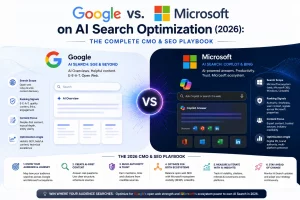
You shouldn’t trust it as a universal answer. It covers Google’s surfaces only. ChatGPT, Perplexity, Claude, Gemini consumer, and retail RAG engines each have their own retrieval architectures. Multi-engine AEO measurement remains essential.
Our agency has been recommending llms.txt. What do we say to them?
Send them Google’s published guide and the relevant excerpt: “You don’t need to create new machine readable files, AI text files, markup, or Markdown to appear in generative AI search.” Ask them to substantiate the recommendation with their own measurement methodology and named-engine evidence.
How urgent is this if our AEO program is mid-flight?
Urgency depends on what your program is doing. If it is doing SEO foundation work + non-commodity content + multi-engine measurement, almost nothing needs to change. If it is producing per-fan-out pages, FAQ-schema stuffing, or llms.txt deployments as Google AI levers — or worse, violating scaled content abuse policy pause and redirect budget this quarter.
What about AI-generated content? Is that allowed?
Yes, but with conditions. Google’s companion guide requires accuracy, quality, and relevance. AI-generated product images need IPTC DigitalSourceType TrainedAlgorithmicMedia metadata. AI-generated product data must be labeled as AI-generated. And all content must meet Search Essentials and spam policies.